

Berberine for Blood Sugar: What the Research Actually Shows
Is berberine an evidence-based supplement for supporting healthy blood glucose?
Yes, with meaningful caveats. Multiple randomized controlled trials have found berberine associated with reduced fasting glucose and HbA1c in adults with type 2 diabetes or metabolic syndrome. Effect sizes are modest to moderate. Evidence quality varies, and berberine is not a substitute for prescribed medications or lifestyle intervention. Consult your physician before use.
This post is journalism, not medical advice. It does not substitute for a conversation with your physician or pharmacist.
What Is Berberine, and Where Does It Come From?
Berberine is an alkaloid compound found in several plants — most commonly Berberis aristata (Indian barberry), Berberis vulgaris (common barberry), goldenseal (Hydrastis canadensis), and Oregon grape. It has a long history in both Traditional Chinese Medicine and Ayurvedic practice, where it was used for digestive and antimicrobial purposes long before researchers began studying its metabolic effects.
Chemically, berberine is classified as an isoquinoline alkaloid. It has a bright yellow color and a distinctive bitter taste. Most modern supplements standardize to berberine hydrochloride (berberine HCl), the salt form that is more stable and easier to measure.
Interest in berberine’s blood sugar effects accelerated significantly after a 2008 study published in Metabolism (DOI: 10.1016/j.metabol.2008.04.030) compared berberine directly against metformin — one of the most commonly prescribed type 2 diabetes drugs — and found broadly comparable reductions in fasting glucose, postprandial glucose, and HbA1c over a 13-week period. That comparison launched a decade of follow-on research and, eventually, a consumer supplement boom.
It is worth being precise about what that finding does and does not mean. A single study comparing berberine to metformin does not establish that berberine is metformin, or that the two are interchangeable. It means the effect sizes overlapped in that specific trial population. The safety profile, mechanism, interaction risk, and long-term data for the two compounds differ considerably.
OTC berberine supplements typically retail for $20–$40 for a 60-day supply, depending on brand and capsule count. That price accessibility is part of why consumer interest has grown — it is substantially cheaper than many prescription alternatives for people without adequate drug coverage.
How Does Berberine Work on Blood Sugar?
The primary mechanism researchers have identified is AMPK activation. AMPK (AMP-activated protein kinase) is sometimes called the body’s “master metabolic switch.” When activated, it improves insulin sensitivity, inhibits glucose production in the liver (gluconeogenesis), and promotes glucose uptake in muscle cells.
This mechanism is, notably, overlapping with how metformin operates — which helps explain why the 2008 comparison study found similar glucose outcomes. Both compounds appear to work partly through the same pathway, although the specific binding targets and downstream effects are not identical.
A 2015 meta-analysis published in Evidence-Based Complementary and Alternative Medicine (DOI: 10.1155/2015/905749) pooled results from 14 randomized controlled trials and found berberine produced statistically significant reductions in:
- Fasting blood glucose (mean reduction: ~20 mg/dL across trials)
- Postprandial blood glucose (2-hour post-meal readings)
- HbA1c (mean reduction: approximately 0.7–1.0 percentage points)
These are not trivial numbers. A 1-point HbA1c reduction is roughly comparable to what some oral diabetes medications achieve in similar populations. However, the meta-analysis authors flagged important limitations: most included trials were small (under 100 participants), conducted predominantly in Chinese populations, and short in duration (typically 8–16 weeks). Longer-term safety and efficacy data remain sparse.
Additional proposed mechanisms include modulation of gut microbiota, reduction of intestinal glucose absorption, and mild inhibition of alpha-glucosidase (an enzyme that breaks down carbohydrates into sugar). Research on these pathways is ongoing and less conclusive than the AMPK evidence.
What the Research Looks Like in Practice
It is worth walking through what the better-designed studies actually measured, so readers can calibrate their expectations.
The 2008 Zhang et al. trial (Metabolism, DOI: 10.1016/j.metabol.2008.04.030) enrolled 116 patients with newly diagnosed type 2 diabetes. Participants were randomized to berberine 500 mg three times daily or metformin 500 mg three times daily. After 13 weeks:
- Fasting glucose dropped 35.9% in the berberine group vs. 36.1% in the metformin group
- Postprandial glucose dropped 44.7% vs. 44.1%
- HbA1c fell from 9.5% to 7.5% (berberine) and from 9.5% to 7.6% (metformin)
These are substantial improvements — but this was a population with significantly elevated baseline glucose. People with normal blood sugar would not expect anything close to this magnitude of effect.
A 2012 RCT (Journal of Clinical Endocrinology & Metabolism, DOI: 10.1210/jc.2011-2671) focused on metabolic syndrome rather than diagnosed diabetes and found berberine associated with reductions in fasting glucose, triglycerides, and waist circumference compared to placebo. Effect sizes were smaller than in the diabetes-specific trials, which is consistent with baseline glucose levels being lower.
What is missing from the literature is meaningful long-term data. Most trials run 12–24 weeks. There are no large, multi-year RCTs on berberine with cardiovascular endpoints, cancer risk, or all-cause mortality — the kinds of outcomes that define whether a metabolic drug is genuinely useful over a lifetime.
Safety, Side Effects, and Drug Interactions
Berberine has a reasonably well-characterized short-term safety profile based on trial data. The most common side effects are gastrointestinal: nausea, cramping, diarrhea, and constipation, typically dose-dependent and most common when starting supplementation. Dividing doses with meals (e.g., three smaller doses rather than one large dose) appears to reduce GI complaints in most users.
More significant concerns involve drug interactions. Because berberine is metabolized by cytochrome P450 enzymes — particularly CYP3A4 and CYP2D6 — it has the potential to affect how other medications are processed by the liver. Specific interactions to discuss with your physician before starting berberine include:
- Blood sugar medications (metformin, sulfonylureas, insulin): additive glucose-lowering effects could increase hypoglycemia risk
- Blood thinners (warfarin, direct oral anticoagulants): some evidence of interaction via CYP enzyme competition
- Statins (particularly simvastatin and lovastatin): berberine may slow their metabolism, potentially raising statin blood levels
- Cyclosporine and other immunosuppressants: similar enzyme competition concerns
Berberine is also generally contraindicated in pregnancy due to animal data suggesting potential harm to fetal bilirubin processing.
The FDA classifies berberine as a dietary supplement, not a drug. This means it is not subject to the same pre-market efficacy and safety review as pharmaceuticals. What you see on a supplement label is not verified by the FDA before sale.
How to Evaluate Berberine Supplements
Not all berberine products are equivalent. Because the supplement market is not tightly regulated, potency and purity vary between brands. When evaluating a berberine supplement, look for:
Third-party testing: Look for products verified by NSF International, USP, or Informed Sport. These programs test for label accuracy and contaminants — a meaningful but not absolute quality signal.
Standardized berberine HCl: Most trial data used berberine hydrochloride. Products that specify the salt form and percentage are more transparent than those listing only “berberine extract.”
Dose transparency: Clinical trials typically used 500 mg doses taken two to three times daily (1,000–1,500 mg total daily). Products with vague “proprietary blend” dosing make it impossible to know whether you are matching studied doses.
Price and return policy: Expect to pay $20–$40 for a quality 60-day supply. Significantly cheaper products are more likely to reflect manufacturing corners cut. Significantly more expensive products in this category often reflect marketing spend, not superior formulation.
FAQ
Can berberine replace metformin or other diabetes medications?
No. Berberine should not replace prescribed medications without your physician’s explicit guidance. The 2008 trial showing comparable short-term effects to metformin is a single study in a specific population. Long-term safety data for berberine is far thinner than for metformin, which has decades of clinical use and well-characterized outcomes data.
How long does it take berberine to affect blood sugar?
Trial data generally shows measurable changes in fasting glucose within 4–8 weeks of consistent use. Most trials ran 12–16 weeks to assess HbA1c changes, which reflect a 3-month blood sugar average and cannot meaningfully shift faster than that window.
Is berberine the same as “nature’s Ozempic”?
No. This claim circulated on social media and has no scientific basis. GLP-1 receptor agonists like semaglutide work via a completely different mechanism and have substantially more robust clinical trial data, including cardiovascular outcomes studies. Berberine and GLP-1 agonists are not comparable compounds.
Does berberine cause low blood sugar (hypoglycemia)?
Berberine alone, in people not on other glucose-lowering medications, appears to carry low hypoglycemia risk based on trial data. The concern rises significantly if berberine is combined with insulin, sulfonylureas, or other glucose-lowering agents.
Is berberine safe for long-term use?
Honest answer: we do not have strong long-term data. Most trials are under 6 months. There are no large multi-year safety studies comparable to what exists for metformin or statins. This is a genuine gap in the evidence, not a reason to panic — but it is a reason to use berberine with periodic physician check-ins rather than treating it as indefinitely self-managed.
This post is intended for informational purposes only and does not constitute medical advice. Always consult a qualified healthcare provider before starting any supplement, particularly if you take prescription medications or have a diagnosed health condition.
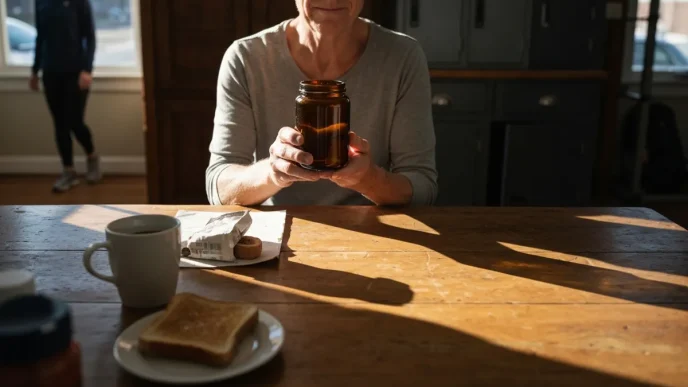
A person in their mid-fifties sits at a worn kitchen table in warm morning window light, one hand wrapped around a ceramic coffee mug and the other resting near a small ceramic dish holding two amber capsules beside a glass of water, a notebook open to handwritten notes blurred softly in the background — documentary editorial photography, no text in frame, no brand markings, no logos, no readable labels, no captions, no signs, single coherent scene.
Created by Healthify Ed Support