Ashwagandha Supplements Reviewed: Comparing KSM-66 vs. Sensoril Extracts
Which ashwagandha extract has stronger clinical backing for stress and cortisol reduction?
Both KSM-66 and Sensoril are patented, clinically studied ashwagandha root extracts with genuine evidence for stress and cortisol reduction. KSM-66 has more published human trials and a broader range of studied outcomes; Sensoril’s evidence base is smaller but credible. Neither extract is dramatically superior for every person or every goal.
This post is not medical advice. Consult your physician before adding any supplement to your routine, particularly if you take prescription medications or have thyroid, autoimmune, or liver conditions.
What Is Ashwagandha, and Why Do Extracts Matter?
Ashwagandha (Withania somnifera) is an adaptogenic herb from Ayurvedic medicine. The parts of the plant used — root versus leaf — and the method used to concentrate its active compounds both influence what you’re actually getting in a capsule.
The active compounds most researchers focus on are withanolides, a class of steroidal lactones. Raw ashwagandha root powder contains roughly 0.5–1% withanolides by weight. Standardized proprietary extracts concentrate this significantly — typically to 5–10% — and are manufactured under controlled conditions with batch testing.
That distinction matters for one practical reason: when you see a clinical trial reporting that “ashwagandha reduced cortisol by X%,” the result is only as applicable to you as the extract in the trial matches what’s in your bottle. Trials conducted on KSM-66 don’t automatically transfer to a generic root powder product, and vice versa. This is a meaningful gap that most supplement marketing glosses over.
KSM-66 is manufactured by Ixoreal Biomed in India. It is a root-only extract standardized to ≥5% withanolides, produced through a milk-based extraction process the company says replicates traditional Ayurvedic preparation. It is one of the most frequently studied ashwagandha extracts, with over 24 gold-standard clinical trials listed by the manufacturer.
Sensoril is produced by Natreon, Inc. It uses both root and leaf material from the plant, standardized to ≥10% withanolides and ≥32% oligosaccharides. Because it uses leaf material, withanolide concentration is higher per gram — which also means typical doses are lower (125–250 mg for Sensoril vs. 300–600 mg for KSM-66).
Neither extract is better “in general.” They have different compositions, different studied doses, and somewhat different clinical track records. The right choice depends on what outcome you’re prioritizing.
KSM-66: Evidence Summary
KSM-66 has the deeper published research record of the two. Key human trials include:
Stress and cortisol: A randomized, double-blind, placebo-controlled trial published in the Indian Journal of Psychological Medicine (Chandrasekhar et al., 2012; PMID 23439798) found that 300 mg KSM-66 twice daily for 60 days was associated with a 27.9% reduction in serum cortisol and significant improvements on the Perceived Stress Scale (PSS) compared to placebo. Sample size was 64 adults. This is one of the most-cited ashwagandha trials in existence.
Thyroid function: A 2018 trial in the Journal of Alternative and Complementary Medicine (PMID 28829155) found 600 mg/day KSM-66 for eight weeks was associated with significant increases in T3 and T4 levels in subclinical hypothyroid patients. This is relevant context: if you have thyroid conditions, this extract may affect thyroid hormone levels, which is a reason to consult a physician first.
Physical endurance and testosterone: Multiple smaller trials (e.g., Wankhede et al., 2015, PMID 26609282) found associations between KSM-66 use and improved VO2 max, muscle recovery, and testosterone levels in resistance-trained men. These trials are typically small (under 60 participants) and short (8–12 weeks), so treat the evidence as promising but not conclusive.
Overall: KSM-66’s research portfolio is broader and covers a wider range of endpoints. If you’re buying ashwagandha primarily for stress and cortisol reduction — the most common use case — KSM-66 has more direct, replicable trial evidence.
Typical retail cost for a 60-count KSM-66 product (300 mg/capsule, equivalent to the Chandrasekhar dosing protocol) runs approximately $20–35 for a 30-day supply at standard online retailers.
Sensoril: Evidence Summary
Sensoril’s clinical record is smaller, but not weak. It has been studied in at least a half-dozen human trials, with a particular focus on stress biomarkers and cognitive function.
Stress and cortisol: A randomized controlled trial published in the Journal of the American Nutraceutical Association (Auddy et al., 2008) found that 125 mg and 250 mg Sensoril daily for 60 days were both associated with significant reductions in serum cortisol, C-reactive protein, and PSS scores compared to placebo. The 250 mg dose outperformed the 125 mg dose on most measures. Sample size was 98 adults, which is moderately sized for supplement research.
Cognitive function and fatigue: A 2017 randomized controlled trial in the Journal of Ayurveda and Integrative Medicine (PMID 28471731) found 300 mg Sensoril daily for 8 weeks was associated with improvements in cognitive task performance and self-reported fatigue levels. This is one of the cleaner trials supporting a cognition-focused use case for Sensoril.
Comparison caveat: Because Sensoril uses leaf material and has a higher withanolide concentration per gram, its dose is lower — but “higher withanolides” doesn’t automatically mean “more effective.” The clinical trials on each extract used different doses, different outcome measures, and were conducted by different research groups. A head-to-head trial comparing KSM-66 and Sensoril directly does not, to this author’s knowledge, exist in the published literature as of this writing.
Sensoril-containing products tend to be positioned at a slightly lower per-dose cost given the smaller gram amount per serving, but finished product pricing varies widely. Expect to pay roughly $18–30 for a 30-day supply at comparable quality tiers.
KSM-66 vs. Sensoril: Side-by-Side Comparison
| Feature | KSM-66 | Sensoril |
|---|---|---|
| Plant parts used | Root only | Root + leaf |
| Withanolide standardization | ≥5% | ≥10% |
| Typical studied dose | 300–600 mg/day | 125–250 mg/day |
| Human RCT count | 24+ (per manufacturer) | ~6–8 (published) |
| Cortisol reduction evidence | Strong (multiple RCTs) | Moderate (fewer RCTs) |
| Cognitive function data | Limited | Moderate |
| Thyroid effect evidence | Yes — monitor if relevant | Less studied |
| Approximate 30-day cost | $20–35 | $18–30 |
What to Look for When Buying
Regardless of which extract you choose, a few label-reading habits are worth developing:
1. Confirm the extract is named on the label. Products that say “ashwagandha root extract” without naming KSM-66 or Sensoril may use a generic extract with different withanolide concentrations and no clinical backing. The extract name matters.
2. Check the dose matches clinical evidence. A product containing 100 mg of KSM-66 is not equivalent to one containing 300 mg — and the trials were conducted at specific doses. Low-dose inclusion (common in blended “stress formulas”) is a form of ingredient fairy-dusting.
3. Look for third-party testing. NSF Certified for Sport, USP Verified, or Informed Sport certification means an independent lab confirmed the product contains what it claims. This matters more for athletes subject to drug testing, but it’s a reasonable quality signal for anyone.
4. Avoid products with proprietary blends that obscure individual ingredient doses. If the label lists ten adaptogens inside a single “blend” with a total weight, you cannot determine whether any single ingredient is at a clinically relevant dose.
FAQ
Is KSM-66 or Sensoril better for anxiety?
Both have trial evidence for stress reduction as measured by standardized scales (PSS) and cortisol levels. KSM-66 has more published trials on this outcome. Neither has been studied as a treatment for diagnosed anxiety disorders — if anxiety is a clinical concern, this is a physician conversation, not a supplement decision.
Can I take ashwagandha long-term?
Most published trials run 8–12 weeks. There is limited long-term safety data beyond that window. Some traditional Ayurvedic protocols use ashwagandha cyclically rather than continuously. Rare cases of liver injury associated with ashwagandha have been reported (see Björnsson et al., 2020, PMID 32178891), though causality is difficult to confirm. Periodic breaks are a reasonable precaution.
Do ashwagandha extracts interact with medications?
Possibly. Ashwagandha may interact with thyroid medications, immunosuppressants, and sedatives. If you take any of these, consult your prescribing physician before adding ashwagandha.
What does “standardized to X% withanolides” actually mean?
It means the manufacturer has confirmed, through testing, that the extract contains at least that percentage of withanolides by weight per batch. Higher standardization doesn’t always mean better outcomes — the clinical dose and delivery matter too — but it does provide consistency across batches, which raw powder products can’t guarantee.
Are there people who should avoid ashwagandha entirely?
Yes. Ashwagandha should generally be avoided during pregnancy (animal studies suggest possible adverse effects). People with autoimmune conditions (lupus, rheumatoid arthritis, multiple sclerosis) should consult a physician, as ashwagandha is thought to stimulate immune activity. People scheduled for surgery should discontinue use in advance due to potential sedative interactions.
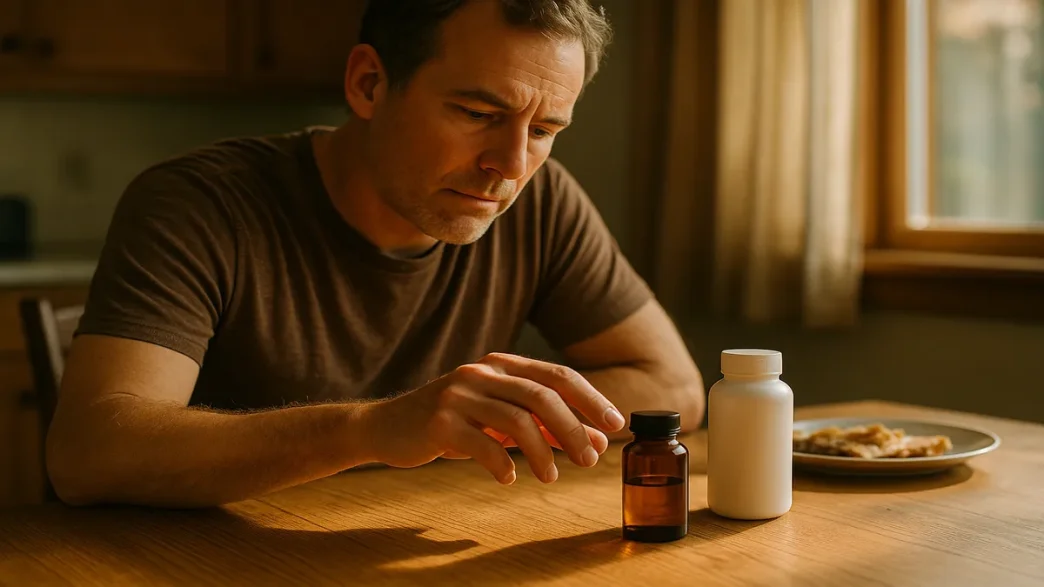
A person in their mid-forties seated at a worn wooden kitchen table in warm early-morning light, one hand relaxed and reaching toward a short amber-glass bottle while a taller white-plastic bottle stands slightly apart, a half-eaten bowl of oatmeal blurred softly in the background, natural window light catching the grain of the table and the faint steam from a ceramic coffee mug, documentary editorial photography, no text in frame, no brand markings, no logos, no readable labels, no captions, no signs, single coherent scene.
Created by Healthify Ed Support