How to Improve Sleep Quality Without Prescription Sleep Aids
What non-pharmaceutical strategies have clinical evidence for improving sleep architecture?
Several non-drug interventions show clinically meaningful improvements in sleep onset, duration, and quality. Cognitive Behavioral Therapy for Insomnia (CBT-I) has the strongest evidence base, outperforming sleep medications in head-to-head trials. Stimulus control, sleep restriction, light therapy, and certain supplements also show real, if variable, benefit depending on the individual.
This post is not medical advice. If you have a diagnosed sleep disorder or take medications affecting sleep, consult your physician before making changes.
Why Prescription Sleep Aids Aren’t Always the Answer
Prescription sleep medications — benzodiazepines, Z-drugs like zolpidem, and newer dual orexin receptor antagonists — can be appropriate tools in specific clinical situations. But they come with tradeoffs worth understanding.
A meta-analysis published in The BMJ (Huedo-Medina et al., 2012; doi: 10.1136/bmj.e8343) found that while sedative hypnotics did improve sleep onset and duration compared to placebo, the effect sizes were modest and the clinical significance was debated. More significantly, tolerance, dependence risk, next-day cognitive impairment, and elevated fall risk in older adults are documented concerns across drug classes.
The American College of Physicians issued a clinical practice guideline in 2016 (Annals of Internal Medicine, doi: 10.7326/M15-2175) explicitly recommending CBT-I as the first-line treatment for chronic insomnia in adults, ahead of pharmacotherapy. That recommendation has held through subsequent updates.
None of this means medications are wrong choices for everyone. It does mean there’s a legitimate evidence base for non-drug strategies that often gets skipped in the clinical visit.
CBT-I: The Highest-Evidence Non-Drug Intervention
Cognitive Behavioral Therapy for Insomnia is not a single technique — it’s a structured protocol combining several components, typically delivered over 6–8 sessions with a trained therapist. The core elements:
Sleep restriction therapy temporarily limits time in bed to match actual sleep time, building sleep pressure and consolidating fragmented sleep. It sounds counterintuitive and often feels difficult in the first week, but the evidence is consistent.
Stimulus control re-associates the bed with sleep (not wakefulness, screen time, or anxiety). Core rules: use the bed only for sleep and sex, get out of bed if awake more than 20 minutes, keep a consistent wake time regardless of how much sleep you got.
Cognitive restructuring addresses the catastrophic thinking patterns that keep people hyperaroused at 2 a.m. — the “if I don’t sleep I’ll ruin tomorrow” spiral that paradoxically prevents sleep onset.
A meta-analysis in Sleep Medicine Reviews (Trauer et al., 2015; doi: 10.1016/j.smrv.2014.10.009) analyzed 11 randomized trials and found CBT-I significantly reduced sleep onset latency, wake after sleep onset, and improved sleep efficiency — with effects that held at long-term follow-up, unlike pharmacotherapy, where effects often diminish after discontinuation.
Access note: In-person CBT-I with a trained therapist is the gold standard but can be difficult to access and costly. Digital CBT-I programs (Sleepio, Somryst — the latter FDA-cleared as a prescription digital therapeutic) have shown comparable efficacy in randomized trials. Sleepio in particular was evaluated in a JAMA Psychiatry study (Espie et al., 2019; doi: 10.1001/jamapsychiatry.2019.0193) with positive findings.
Light Exposure and Circadian Rhythm Management
Your sleep timing is largely governed by your circadian clock, which is entrained primarily by light — specifically the timing, intensity, and spectrum of light you’re exposed to.
Morning light is the most powerful entrainment signal. Getting 10–30 minutes of bright natural light within an hour of waking suppresses melatonin and advances your circadian phase. Research on light therapy (often using 10,000 lux lightboxes) is most robust for seasonal affective disorder and circadian rhythm disorders, but there is meaningful evidence it helps general sleep timing in people with delayed sleep phase tendencies (Lack et al., 2005; doi: 10.1080/07420520590928581).
Evening light suppresses melatonin. A study out of Harvard’s Division of Sleep Medicine (Chang et al., 2015; doi: 10.1073/pnas.1418490112) found that reading on a light-emitting device before bed delayed melatonin onset by about 1.5 hours compared to reading a printed book. Blue-light filtering settings and glasses reduce but do not eliminate this effect.
Practical application: Get outside in the morning, even on cloudy days (cloud cover still delivers substantially more lux than indoor lighting). Dim overhead lights after sunset. Use warm-spectrum bulbs in the bedroom.
Temperature, Environment, and Sleep Architecture
Core body temperature naturally drops as part of sleep initiation — the body dissipates heat through the hands and feet, and a cooler sleep environment supports this process.
Research suggests an optimal bedroom temperature range of roughly 65–68°F (18–20°C) for most adults, though individual variation exists (Okamoto-Mizuno & Mizuno, 2012; doi: 10.1186/1476-069X-11-40). What matters physiologically is the drop in core temperature — a warm bath or shower 1–2 hours before bed paradoxically aids sleep onset by drawing blood to the skin and accelerating that heat dissipation (Haghayegh et al., 2019; doi: 10.1016/j.smrv.2019.04.008).
Other environmental factors with evidence worth noting:
- Noise: Even traffic noise that doesn’t wake you measurably fragments sleep architecture. White noise or earplugs can attenuate this effect in urban environments.
- Darkness: Blackout curtains or a sleep mask reduce light intrusion. This matters more than many people realize — even low-level ambient light affects melatonin secretion.
Supplements With Meaningful Evidence (and Honest Caveats)
Several OTC supplements have genuine research support for specific sleep complaints. The evidence is not uniformly strong, and supplement quality control in the U.S. is limited — this is worth flagging honestly.
Melatonin is most effective for circadian-based issues (jet lag, shift work, delayed sleep phase) rather than general insomnia. A 2013 Cochrane review (Ferracioli-Oda et al., PLOS ONE; doi: 10.1371/journal.pone.0063773) found melatonin reduced sleep onset by about 7 minutes and increased total sleep time by about 8 minutes — statistically significant but modest. Lower doses (0.5–1 mg) appear as effective as higher doses and carry fewer next-day effects. OTC, typically ~$8–15 for a 60-day supply at low doses.
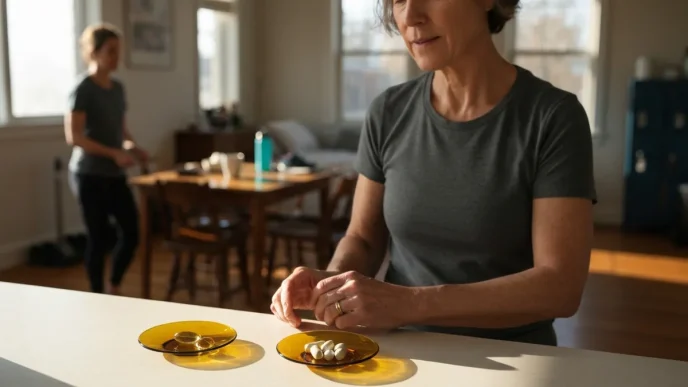
Magnesium glycinate is associated with improved sleep quality in older adults with magnesium insufficiency (Abbasi et al., 2012; doi: 10.1186/1472-6882-12-161). The mechanism is plausible — magnesium plays a role in GABA receptor function and melatonin production — but the evidence base is small and largely limited to populations with baseline deficiency. Worth trying if dietary intake is low; not a guaranteed intervention. OTC, ~$15–25 for a 30-day supply.
L-theanine, an amino acid found in tea, is associated with reduced sleep latency and self-reported relaxation in small studies, with a reasonable safety profile. The evidence is preliminary. OTC, ~$10–20 for a 30-day supply.
Valerian root has mixed trial results — some studies show modest benefit, others show no difference from placebo. It’s not clearly effective enough to recommend strongly, but it is widely used and considered low-risk.
Important caveat: Look for supplements with third-party testing verification (USP, NSF, or Informed Sport seals) given the lack of pre-market FDA review for supplements.
Exercise and Sleep: A Two-Way Relationship
Regular physical activity is consistently associated with improved sleep quality in both observational and intervention studies. A meta-analysis in Mental Health and Physical Activity (Kredlow et al., 2015; doi: 10.1016/j.mhpa.2015.02.002) found moderate, consistent effects of exercise on sleep onset, duration, and efficiency.
The timing question — whether evening exercise disrupts sleep — is more nuanced than often portrayed. A 2018 meta-analysis in Sports Medicine (Stutz et al., doi: 10.1007/s40279-018-1015-0) found that vigorous exercise ending less than one hour before bed was associated with worse sleep, but moderate exercise finishing 2+ hours before bed was not. Individual variation is real here.
The mechanism likely involves sleep homeostasis — the adenosine buildup that creates sleep pressure — along with body temperature effects and anxiety reduction.
FAQ
How quickly can CBT-I improve sleep?
Most structured CBT-I programs run 6–8 weeks. Many people notice changes in sleep efficiency by weeks 3–4, though the first week of sleep restriction often feels harder before it gets better. Effects tend to be more durable than medication-based improvement.
Is melatonin safe for long-term use?
Long-term safety data are limited, but existing research doesn’t suggest significant harm in adults. Because melatonin is most effective for circadian issues rather than general insomnia, long-term use without addressing underlying causes may not be the most effective approach regardless.
Does alcohol help with sleep?
Alcohol shortens sleep onset but consistently degrades sleep architecture — particularly REM sleep — in the second half of the night. A 2015 review in Alcoholism: Clinical and Experimental Research (doi: 10.1111/acer.12926) confirmed dose-dependent REM suppression. It is not a useful sleep aid.
What if I’ve tried these strategies and still can’t sleep?
Persistent insomnia despite consistent behavioral changes warrants a medical evaluation. Underlying conditions — sleep apnea, restless legs syndrome, depression, thyroid dysfunction — can drive insomnia and require separate treatment. A sleep study may be appropriate depending on your symptom pattern.
Can I combine these strategies?
Yes, and most structured programs do combine them. CBT-I itself integrates behavioral, cognitive, and environmental components. Adding morning light exposure, exercise, and judicious supplement use on top of CBT-I is a reasonable, evidence-informed approach.
This is not medical advice. Consult your physician before making changes to your sleep regimen, particularly if you take medications or have a diagnosed sleep disorder.
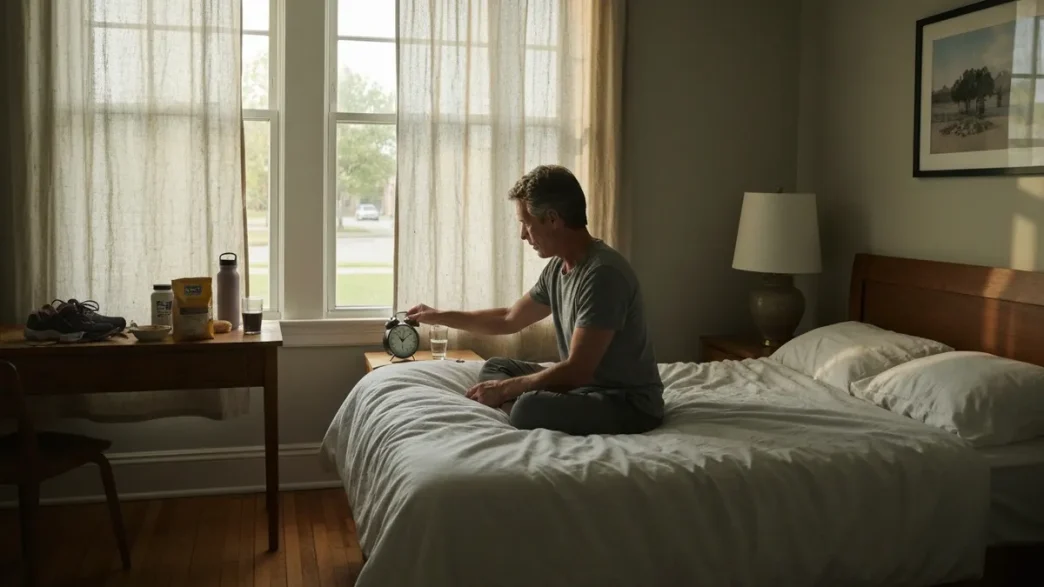
A person in their mid-fifties sits at the edge of a neatly made bed in a dim bedroom, the first pale light of dawn filtering through linen curtains, reaching to set a simple alarm clock on the nightstand beside a glass of water, the room lived-in and quiet, documentary editorial photography, no text in frame, no brand markings, no logos, no readable labels, no captions, no signs, single coherent scene.
Created by Healthify Ed Support