

How to Build a Morning Routine That Actually Supports Cortisol Balance
What morning habits are supported by evidence for healthy cortisol rhythms?
Light exposure within 30 minutes of waking, avoiding high-sugar meals early in the morning, and moderating intense exercise to mid-morning appear to support the natural cortisol awakening response (CAR). Evidence is strongest for light exposure; habits like cold water and breathing exercises show early-stage but promising research. Individual variation is significant.
This post is for informational purposes only and is not medical advice. Consult your physician before changing your health routine, especially if you have a diagnosed cortisol-related condition.
Understanding the Cortisol Awakening Response
Before building any routine around cortisol, it helps to understand what a healthy pattern actually looks like.
Cortisol is often framed as a purely negative “stress hormone,” but that framing is incomplete. In a healthy individual, cortisol follows a diurnal rhythm: it rises sharply in the 30–45 minutes after waking — a pattern researchers call the cortisol awakening response (CAR) — peaks in mid-morning, then gradually declines across the day, reaching its lowest point around midnight.
This morning surge is not a sign of stress. It’s your body priming metabolic function, immune activity, and cognitive readiness for the day ahead. A blunted CAR is associated with fatigue, low mood, and burnout; an exaggerated or prolonged elevation is associated with chronic stress and sleep disruption. Both are worth taking seriously.
The key research foundation here is work published in journals like Psychoneuroendocrinology, which has documented the CAR across thousands of participants. One widely-cited review (Clow et al., 2004, Neuroscience & Biobehavioral Reviews, doi:10.1016/j.neubiorev.2004.06.002) established the CAR as a reliable biomarker of HPA-axis function. That study’s limitation, worth noting, is that it relied heavily on self-collected saliva samples, which are sensitive to collection timing errors.
The practical implication: your morning routine doesn’t need to suppress cortisol. It needs to work with the natural arc — supporting the healthy morning rise and then promoting a gradual comedown across the rest of the day.
Step 1 — Get Bright Light Into Your Eyes Early
The most robustly supported morning habit for cortisol regulation is simple: get outside within 30 minutes of waking and expose your eyes to natural light for at least 10 minutes.
Light is the primary signal that entrains your circadian clock via retinal photoreceptors (specifically intrinsically photosensitive retinal ganglion cells, or ipRGCs) that project to the suprachiasmatic nucleus (SCN). The SCN, in turn, coordinates cortisol release through the HPA axis. When this light signal is delayed — as happens when you spend the first hour of your day in dim artificial light or staring at a phone — circadian timing drifts, and the CAR can become blunted or mistimed.
Research supporting morning light and cortisol includes a study by Leproult et al. published in Sleep (1997), and more recent mechanistic work reviewed in Frontiers in Physiology (Blume et al., 2019, doi:10.3389/fphys.2019.00099). Strength of evidence: moderate to strong for circadian effects; the specific cortisol mechanism is well-supported at the theoretical level, with correlational human data backing it up.
Practical implementation:
– Step outside with your first cup of coffee or tea — even on overcast days, outdoor light is 10–50x brighter than indoor lighting.
– On rainy or winter-dark days, a 10,000-lux light therapy box positioned at eye level for 20 minutes is a reasonable substitute. These run approximately $30–$80 OTC.
– Avoid sunglasses during this window; they filter the frequencies that drive the circadian response.
Step 2 — Time Your Exercise Thoughtfully
Exercise is one of the most potent acute stimulators of cortisol — which is not a problem, but timing matters for how you feel later in the day.
High-intensity exercise (think sprints, heavy lifts, HIIT) raises cortisol sharply as part of the normal stress-adaptation response. When done mid-morning (roughly 9–11 a.m.), this spike aligns with the natural cortisol peak, and the subsequent decline dovetails with the body’s own downward arc.
High-intensity training done very early (5–6 a.m.) before the CAR has fully expressed, or in the evening, can disrupt the natural decline. Evening high-intensity training in particular is associated with elevated nighttime cortisol and poorer sleep quality in some studies (Hackney, 2006, Current Sports Medicine Reports).
This doesn’t mean early morning training is harmful — millions of people do it without issue. But if you’re struggling with poor sleep or afternoon energy crashes, shifting intense sessions to mid-morning is a low-cost variable to test.
Lower-intensity movement — a 20-minute walk, yoga, light stretching — appears largely neutral with respect to cortisol timing and can be done at any morning hour without concern.
Step 3 — Be Deliberate About What (and When) You Eat
Your first meal influences cortisol indirectly through blood glucose regulation. A sharp glycemic spike early in the morning — from a high-sugar breakfast, fruit juice, or a sweetened coffee drink — can trigger a compensatory cortisol response as the body works to restore glucose balance.
This is not the same as saying “carbs are bad.” The mechanism is about rate of glucose rise, not carbohydrates per se. A meal with protein, fiber, and slower-digesting carbohydrates tends to produce a more gradual glucose curve.
Research on meal timing and cortisol is more preliminary than the light data. A study in Nutrition Research (Witbrock et al., 2019) found associations between breakfast composition and morning cortisol in shift workers, though the design doesn’t support strong causal claims.
Practical suggestions:
– Prioritize protein and fat in the first meal (eggs, Greek yogurt, nuts, smoked fish) alongside complex carbohydrates if desired.
– If you practice time-restricted eating or intermittent fasting, note that some research — including work in Obesity (Sutton et al., 2018, doi:10.1016/j.omet.2018.06.001) — suggests earlier eating windows (e.g., 8 a.m.–4 p.m.) may be more metabolically aligned than late ones, though this research is ongoing and individual tolerance varies significantly.
– Skip the sweetened coffee drinks and fruit juice in the first hour; black coffee, tea, or water are fine.
Step 4 — Manage Psychological Stress Before It Manages You
Psychological stressors are among the strongest acute drivers of cortisol elevation — and many of us front-load our stressors: email, news, notifications, and work demands in the first 30 minutes of waking.
There’s no single study proving “don’t check email before 8 a.m.” as a cortisol intervention. But the HPA-axis research on anticipatory stress is consistent: perceiving threat or unresolved demands raises cortisol, and deliberately delaying exposure to those inputs gives the CAR time to express and resolve naturally.
Slow diaphragmatic breathing is one technique with reasonable mechanistic support. Studies measuring heart rate variability (a proxy for autonomic nervous system regulation) show that slow breathing (approximately 5–6 breaths per minute) shifts balance toward parasympathetic activity, which is associated with lower cortisol in some but not all study designs. A 2017 meta-analysis in Frontiers in Human Neuroscience (Zaccaro et al., doi:10.3389/fnhum.2018.00353) found significant effects on cortisol from slow-paced breathing interventions, though many included studies were small.
Practical suggestions:
– Give yourself a 20–30 minute “phone-free” window after waking.
– Try 5 minutes of slow nasal breathing (4 counts in, 6 counts out) before opening communications.
– Journaling and brief mindfulness have softer evidence but consistent self-reported effects on perceived stress — meaningful even when biomarkers are inconclusive.
Putting It Together: A Realistic Morning Framework
Here’s what a cortisol-supportive morning might look like in practice — not a rigid prescription, but a template you can adapt:
| Time (relative to waking) | Habit | Evidence strength |
|---|---|---|
| 0–5 min | Avoid phone; drink water | Indirect / low |
| 5–30 min | Outdoor light exposure (10–15 min) | Moderate–strong |
| 30–60 min | First meal with protein + fiber | Moderate |
| 60–90 min | Slow breathing or brief mindfulness | Early-stage |
| 90–180 min | Movement: walk or low-intensity | Moderate |
| Mid-morning | High-intensity exercise if desired | Moderate |
No single habit here is a cure for dysregulated cortisol, which can have clinical causes including adrenal insufficiency, Cushing’s syndrome, or chronic overtraining syndrome. If you suspect a clinical issue, work with a physician who can order appropriate testing (serum cortisol, salivary CAR panels).
FAQ
Does coffee spike cortisol in the morning?
Caffeine does raise cortisol acutely. Some researchers suggest waiting 60–90 minutes after waking before drinking coffee, to avoid compounding the natural CAR with a caffeine-driven spike. Evidence is real but modest; for most people this is a fine-tuning variable, not a make-or-break rule. Black coffee is still far better than a high-sugar drink.
Is a cold shower good for cortisol balance?
Cold water immersion produces a short-term cortisol spike as part of the cold-stress response. Whether that spike is beneficial long-term is unclear — some researchers hypothesize hormetic adaptation, but human RCT data supporting cortisol regulation from cold showers specifically is very thin. It’s not harmful for healthy adults, but don’t expect it to be a primary lever.
Can supplements support healthy cortisol rhythms?
Some adaptogens — particularly ashwagandha — have more than preliminary evidence. A double-blind RCT published in Medicine (Chandrasekhar et al., 2012, doi:10.1097/MD.0000000000013929) found significant reductions in serum cortisol in stressed adults. Evidence is stronger for perceived stress than for diurnal rhythm specifically. Supplements should complement, not replace, behavioral foundations.
How long does it take to shift cortisol patterns?
Circadian rhythms are relatively plastic. Light exposure interventions show measurable effects on melatonin and cortisol within 3–7 days in most studies. Sustained behavioral changes — consistent sleep schedule, regular exercise timing, stress management — take several weeks to produce reliable HPA-axis shifts. Patience and consistency matter more than perfection.
Should I worry if I’m not a morning person?
Chronotype (your natural tendency toward morning or evening preference) is partly genetic and affects when your CAR peaks. Evening chronotypes have a later-shifted cortisol curve. Forcing early morning routines against a strong evening chronotype may itself be a stressor. Work with your natural rhythm where possible — shift the timing of these habits rather than abandoning them.
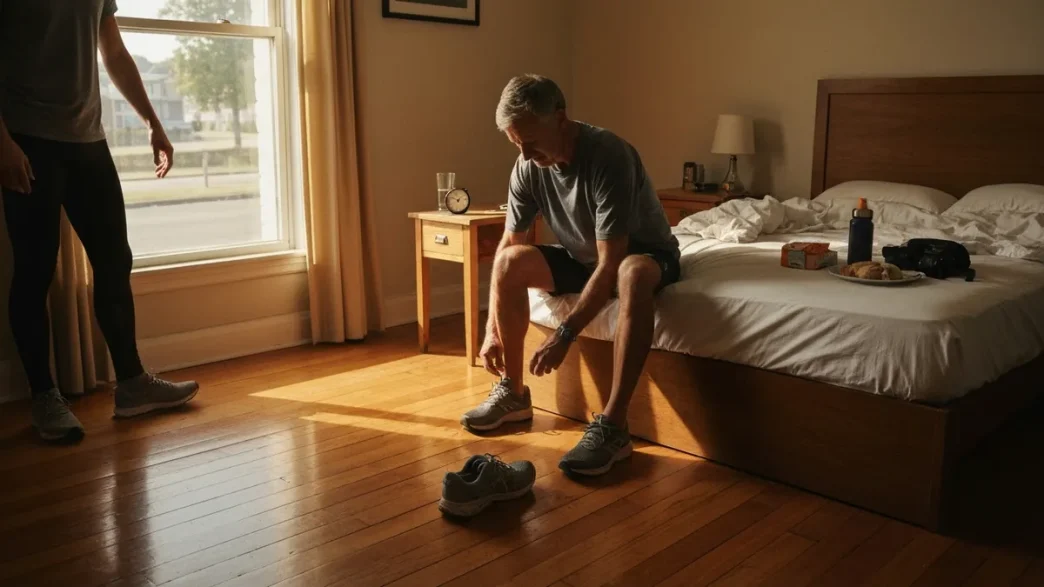
A person in their mid-fifties sitting at the edge of a bed at dawn, tying running shoes on a worn hardwood floor, soft warm light filtering through wooden window blinds, workout clothes folded neatly on a nearby wooden chair, the room lived-in and unhurried, documentary editorial photography, no text in frame, no brand markings, no logos, no readable labels, no captions, no signs, single coherent scene.
Created by Healthify Ed Support